An article can acquire a second record
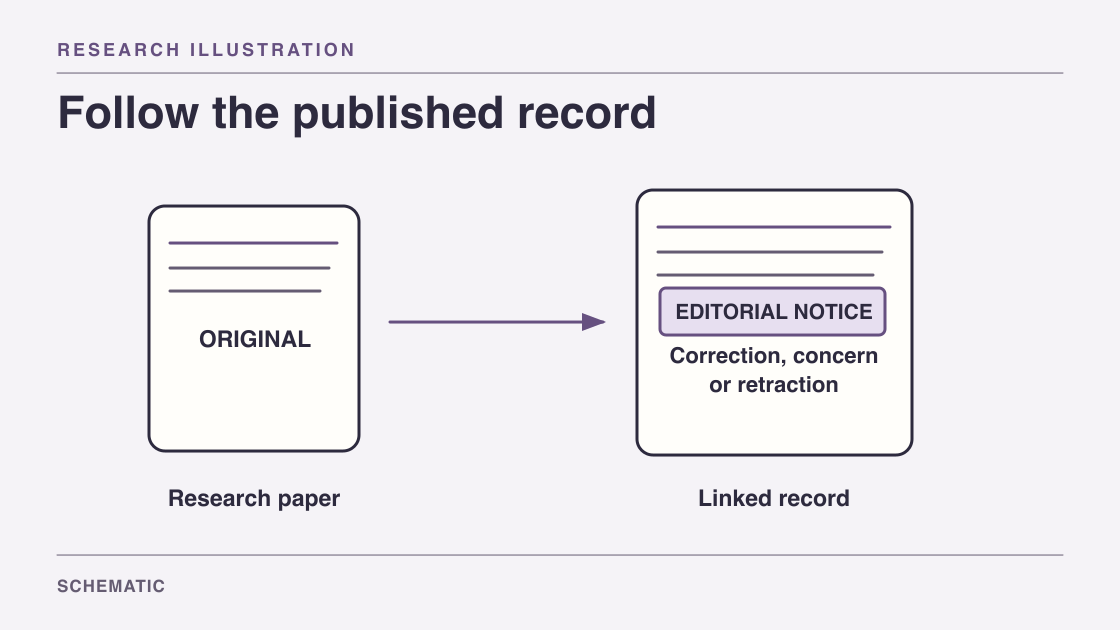
A research paper can stay at the same address for years while the information attached to it changes. The change may be easy to miss if you reached the article through an old bookmark or already had a PDF. A journal can add a separate, dated notice that explains what happened after publication. That notice may point back to the original, and the original page may gain a link to the notice. This preserves the trail a later reader needs to follow. Two people can cite the same paper and be relying on different versions of what the journal says about it. [1] [2] [3]
Three labels are especially useful. A correction identifies a mistake that can be put right. An expression of concern alerts readers while questions remain. A retraction formally changes the paper’s status and warns readers against relying on it as ordinary evidence. The article and notice usually remain linked in the published record. Journals do not all use identical procedures, and the notice is the most useful account of what a particular decision means. The label alone will not tell you whether a correction changed a sample count, a numerical result or an author’s name. To know that, open the dated notice and compare it with the claim you intend to use. [1] [2] [3]
What a correction can preserve
Imagine a paper where the caption for a graph assigns the wrong name to one of two lines. The journal can publish a correction identifying the graph, explaining which label changed and giving readers a way to find the corrected version. The exact implications depend on whether the error appeared in the drawing alone, in the analysis, or in both. Guidance from the International Committee of Medical Journal Editors recommends a citable correction that details the changes and a record of the versions. That creates a clear way to explain why an older screenshot and the current online article differ. [2] [3]
A correction can matter even when the overall conclusion stands. A reader extracting one value for a review could be misled by a transposed column. Another reader might be interested only in a finding the correction does not touch. A good reading method is to name the claim you need, then locate it in the corrected material. Make a separate note of what the notice says about the rest of the paper. It is easier to communicate what changed if you can point to the affected figure, table, paragraph or data item instead of describing the whole article as corrected. [2] [3]
An expression of concern leaves a question open
An editor can issue an expression of concern when a serious issue warrants readers’ attention and the available evidence does not yet support a final resolution. Investigations can depend on records held outside the journal or on information that is incomplete when the notice appears. The notice gives people a visible reason to reconsider their reliance on the paper in the meantime. In PubMed, the National Library of Medicine links an expression of concern to the article it refers to. The International Committee of Medical Journal Editors advises journals to report the outcome when an investigation concludes. A later notice may also lift the concern or identify a correction or retraction. Reading the first notice alone may therefore give you only part of the timeline. [1] [3] [5]
If you encounter this label while reviewing evidence, identify the issue the notice raises and its scope. A question about whether a data set can be verified would affect a different part of your assessment from a question about authorship. Record the date of the concern and check for subsequent linked notices. That gives you a specific way to explain why you are treating a finding cautiously. It also leaves room for the record to change. The notice warns that a question remains, while later reporting may clarify whether the journal corrected the paper, retracted it or took another step. [1] [3]
A retraction has its own explanation
A retraction can follow a serious error that makes findings unreliable or other substantial problems with the publication. The Committee on Publication Ethics describes retraction as a means of correcting the literature and recommends that a notice be identifiable, linked to the article and clear about the reason. An important distinction is what the notice actually establishes. A major mistake can invalidate findings without an allegation of intentional wrongdoing. The National Library of Medicine says PubMed uses the same retraction indexing category regardless of whether the notice concerns honest error or misconduct. The reason belongs in the notice and any documented investigation. [1] [3]
A retracted article can remain easy to find, with a marked record or notice explaining its status. COPE distinguishes retraction from rare cases where part or all of the text must also be removed. In those cases, the journal should keep the identifying record and explain the removal. That visible trail helps people interpret older references and trace decisions made before the notice. PubMed’s documentation illustrates the two directions of the link. The original article’s record points to the notice under a retraction label, and the separate notice points back to the original. The original title can still be found in searches. Being searchable gives people a path to the record and its history. To rely on the paper’s findings, a reader first needs to know how the notice changes their status. [1] [3]
Check the copy you are reading
Begin on the article page using the title or DOI, the identifier often printed on the first page. Look near the title or abstract for a change notice and examine the links in the record. For biomedical papers, PubMed can offer another route to a linked correction or retraction. Crossref’s Crossmark service can show updates where a publisher participates and deposits the relevant information. These services make a search easier, but their scope matters. For example, a journal may not use Crossmark, or it may not have deposited an update there. A paper’s record with the issuing journal remains an important place to check for the most recent notice. [2] [3] [4]
If your copy was downloaded before a change, put its date or version next to the current record. Then read the notice in full before updating a quote, summary or table. The notice may name a figure or section that can be replaced with a corrected one. A retraction instead changes how the article can be cited as evidence, although it may still be relevant to an account of the publication history. The useful record for a reader is concrete. Write down the article identifier, the date and label of the notice and the exact claim or data item you intended to use. [1] [2] [3] [4]
How to check a paper’s status
- Find the article
Use its title or DOI to reach the current journal record.
- Look for a notice
Check linked corrections, concerns or retractions and their dates.
- Read the scope
Identify the claim, figure or part of the article affected.
- Update your use
Record the version and change your notes or citation as needed.
Carry the update into later work
When a paper has already appeared in notes or a draft, look for each place where the finding was used. A correction may change a number in a chart, a description in the text or a data point entered into a separate table. Those uses can be easy to miss if you update only the bibliography. For an unresolved concern, document which part of the paper you were using and how the notice affects your confidence. That record helps someone else understand both your original reading and the effect of the new information when they return to your work later. [1] [2] [3]
A simple check also helps when you are looking at someone else’s claim. Locate the cited paper, confirm the version and compare the claim with any dated notice. A search engine can lead you to a PDF or to a secondary report that predates the change. The journal and its linked records provide the way to resolve that gap. The question to carry forward is specific. Which version supports this exact sentence? Once you can answer it, you can explain what remains usable, what changed and why your summary takes the form it does. [1] [2] [3] [4]
Questions about changes to papers
Does a correction always change the conclusion?
No. A notice may correct an author name or a single value, or it may change an interpretation. Compare the change with the claim you need. [2] [3]
Is an expression of concern a final decision?
It warns readers about a concern. A subsequent notice may explain the result of an investigation or a later editorial decision. [1] [3] [5]
Sources & further reading
- [1] COPE Retraction Guidelines, version 3 (August 2025)
This hosted copy of the Committee on Publication Ethics guideline explains when editors should consider retraction, what a notice should contain, and when an expression of concern may be appropriate.
- [2] Corrections and Version Control
Medical journal editors’ recommendations explain formal corrections, version histories and republication.
- [3] Errata, Retractions, and Other Linked Citations in PubMed
The National Library of Medicine shows how PubMed labels and links corrections, retractions and expressions of concern.
- [4] Crossmark
Crossref explains how participating publishers flag updates from the online record and eligible copies.
- [5] ICMJE guidance on expressions of concern and retractions
Explains when medical journal editors may publish an expression of concern and how journals should link and label retraction notices.
Method & limitations
This explainer compares guidance from the Committee on Publication Ethics and the International Committee of Medical Journal Editors with the National Library of Medicine’s indexing rules and Crossref’s update service. The examples of errors are illustrative. Individual journals may use different procedures and labels.