The word spending can hide the measure
Suppose one headline says Congress made ten million dollars available for a program. A second says the agency committed six million dollars, and an accounting report shows three million dollars paid so far. All three statements can describe the same program accurately. They are measurements taken at different points. The federal budget vocabulary distinguishes the legal authority to incur obligations, the obligations themselves, and the outlays that generally occur as payments are made. Those distinctions become especially useful when a program runs across more than one fiscal year. A single activity can generate different numbers in the budget document, contract record and payment reports. [1] [2] [3]
Before comparing two figures, find the label in the underlying table. A budget request may describe what the administration would like to fund. A cost estimate can project the effect of a proposal under stated assumptions. Look for the years and baseline used to calculate that change. An enacted measure can provide authority, and execution reports can show how agencies used it. Each document has a purpose and a time frame. A forecast and a later report on what occurred may be worth comparing, but readers need to call them by those names. Otherwise the difference can look like a reporting error when it simply reflects which stage of the process each number describes. [1] [2]
Permission to make a commitment
Budget authority allows a federal agency to incur obligations that will result in outlays. An appropriation is one familiar way for Congress to provide that authority. The authority can have restrictions on the purpose for which it may be used, the period during which new obligations may be incurred and the amounts available. Those details matter when someone says an agency received funding. The dollars described may become available for a particular period and use, and some authority lasts more than one fiscal year. Whether they lead to payments that year depends on what the agency does and when the goods, services or other requirements are met. [1] [2]
For an illustration, assume an enacted measure provides ten million dollars of new authority for equipment and that the agency has no other funds available for the example. The agency then signs a six million dollar contract in that fiscal year. Signing the contract can create a six million dollar obligation under the assumed terms. An obligation records a commitment that can require payment. It does not say the agency paid the entire amount on the day the contract was signed. The difference between the initial authority and the obligation can help readers see how much of the example’s authority has been committed so far. [1] [2] [3]
Payments can arrive in later years
In the same illustration, imagine the supplier delivers the first batch and the agency pays three million dollars by the fiscal year’s close. For this simple contract, that payment gives three million dollars of outlays during the period. If the remaining batch arrives and is paid for in the next fiscal year, those outlays belong to the next period. That is why payments in one year can reflect commitments made earlier. Comparing one year’s new authority with one year’s payments can reveal useful differences in timing, but it does not reconstruct the history of every obligation behind those payments. [1] [2] [3]
Outlays are generally measured on a cash basis in the federal budget, with exceptions such as the treatment of certain credit activities. That makes the ordinary purchase a useful starting point without making it a universal template. The presentation can also distinguish gross from net amounts. Net amounts may reflect specified offsetting collections or receipts. When comparing tables, use a matching basis and check whether amounts are stated in dollars, millions or billions. A figure expressed in millions can look small next to one expressed in billions even though the underlying activity is larger. Labels and units are part of the evidence. [1] [2] [4]
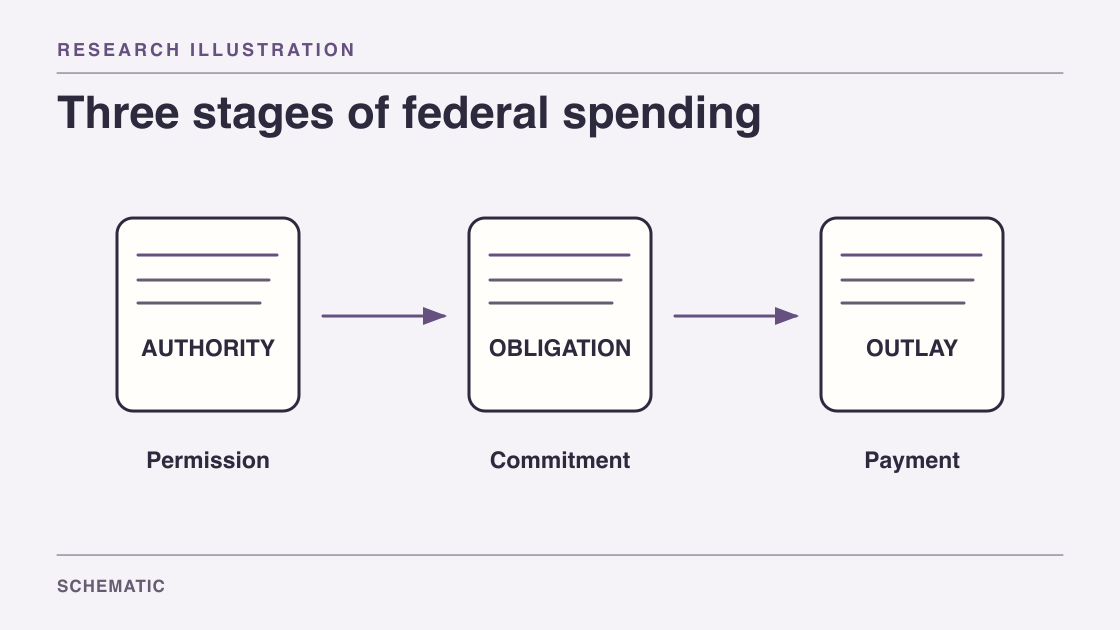
From authority to reported outlays
- Make authority available
An enacted measure lets an agency incur obligations for a purpose.
- Record the commitment
The agency incurs an obligation when it enters a qualifying commitment.
- Make a payment
A routine contract produces outlays as payments are made.
- Report the period
A Treasury statement records outlays within the reporting period.
Where an actual annual figure comes from
The Monthly Treasury Statement reports actual federal budget receipts and outlays and their difference. A fiscal year in the federal budget generally runs from October 1 through September 30. To answer an annual question, find the statement for the closing month and look for the fiscal-year-to-date column or the relevant annual summary. The same document can also carry a column for the single month. A reader interested in the fiscal year needs the cumulative figure. The monthly figure answers how much was recorded during September itself, which is a different period even when both appear on the same page. [2] [4]
Treasury’s December 2024 bulletin gives a historical example. Its combined on- and off-budget table reports about 6.75 trillion dollars of federal outlays and 4.92 trillion dollars of receipts for fiscal year 2024. The resulting deficit was about 1.83 trillion dollars. The published totals are rounded. The example shows why the deficit and spending appear as separate lines. Outlays show spending on the reported basis, and the deficit measures how much those outlays exceeded receipts over the same period. If a discussion uses the deficit number as the spending total, checking the receipts and outlays alongside it will reveal the change in meaning. [1] [4] [5]
Award records answer a narrower question
USAspending gives readers a way to look up federal awards and accounts. An award record can show a contract or grant, its recipient and transactions against it. Account data provide a broader view of budget resources and spending associated with an account. USAspending’s guide explains that award spending is a subset of account spending. Certain payments or activities, including federal employee salaries, do not appear as individual awards. A search filtered to a particular category or recipient can be useful for tracking that category, but it needs to be described as a search of the selected records. A total from the search does not automatically become an agency total. [3]
The same database can also give you figures for more than one measure. Before calling the value on an award page a payment, look for whether the field reports an obligation, an outlay or a different amount such as a potential contract value. An award may have several transactions over time. A total and one of its component transactions describe different levels of aggregation. Use the award identifier and the date range to keep those records aligned. If the question is what the federal government spent in a whole year, the Treasury statement is a better starting point than adding selected awards yourself. [3] [4]
How to make a fair comparison
Write down four things before putting figures side by side. Identify the measure, the reporting period, the entities covered and the accounting basis. Then check that the column labels and units agree. If one number is a future cost estimate and the other is a recorded outlay, describe the comparison explicitly as a forecast alongside an actual. If the periods differ, give the reader both dates. An account can also be reported inside an agency total or by its function across government. Deciding which question you want to answer first will make the choice of table much easier. [1] [2] [3] [4]
For a claim about what was actually spent, start with outlays for the relevant period and scope. For a claim about what an agency committed, start with obligations. For a claim about what it was empowered to commit, look for authority. Keep the reporting document next to your notes so you can see whether the word spending matches the label used by the source. This makes the claim easier for another person to verify and leaves room to explain differences in timing. The best spending figure is the one that measures the activity the sentence says it measures. [1] [2] [3] [4]
Questions about federal spending figures
Is an obligation the same as a payment?
An obligation is a commitment that can require payment. For a routine purchase, an outlay generally occurs when payment is made. [1] [2] [3]
Can an agency pay in a different fiscal year?
Yes. Payments on a commitment made in one year can occur later, depending on the activity and its terms. [1] [2]
Sources & further reading
- [1] A Glossary of Terms Used in the Federal Budget Process
The Government Accountability Office defines budget authority, obligations, outlays and related concepts.
- [2] Congressional Research Service introduction to the federal budget process
Explains the fiscal year, presidential budget requests, the congressional process and the distinction between legal budget authority and outlays.
- [3] Analyst’s Guide to Federal Spending Data
Treasury’s USAspending guide explains award and account records, their coverage and how they report obligations and outlays.
- [4] Monthly Treasury Statement
The Bureau of the Fiscal Service describes the monthly publication that reports federal receipts, outlays and the surplus or deficit.
- [5] Treasury Bulletin for December 2024
The combined on- and off-budget results table reports fiscal year 2024 receipts of $4.919 trillion, outlays of $6.752 trillion, and a deficit of $1.833 trillion after rounding.
Method & limitations
The definitions come from the Government Accountability Office, the Congressional Research Service and the Treasury’s USAspending guide. Treasury’s December 2024 bulletin supplies the historical totals. The equipment contract is an illustration and the article describes U.S. federal budget accounting.