





politics • Jan. 14, 2026
Yoon Suk Yeol’s Fate on the Line in Martial Law Case
Yoon Suk Yeol, the former president of South Korea, is being asked to be put to death for trying to impose martial law in 2024. Before the court makes its decision, this case brings up important issues about democracy and the abuse of power in South Korea.

By Victor V. Haley
Published Jan. 14, 2026
Prosecutors have requested that South Korea's former President Yoon Suk Yeol be sentenced to death if he is convicted of his mishandled attempt to enforce martial law. Special Prosecutor Cho Eun-suk’s team submitted a petition to the Seoul Central District Court on Tuesday, alleging that Yoon threatened the “liberal democratic constitutional order” with his “self-coup”. “The greatest victims of the insurrection in this case are the people of this country,” stated the prosecutors.
“There are no mitigating circumstances to be considered in sentencing, and instead, a severe punishment must be imposed.” A court in Seoul heard concluding arguments in Yoon's trial, in which he was charged with being the ringleader of an insurrection The allegation arises from Yoon's attempted imposition of military rule in South Korea in December 2024—an action that persisted only for a few hours but triggered significant political upheaval in the country. He was subsequently impeached by Parliament and detained to undergo prosecution. Yoon’s criminal prosecution concerning insurrection, abuse of authority, and other related charges stemming from the martial law declaration concluded on Tuesday following 11 hours of proceedings.
The court is scheduled to deliver a verdict in the case on February 19, according to Yonhap News Agency. Yoon Suk Yeol's trial is important as it could globally portray South Korea's stand on dealing and punishing power misusing cases. Yoon Suk Yeol, the ex-president of South Korea is facing a death penalty due to his imposition of martial law in 2024.
Prosecutors demand death penalty for Yoon, with the court yet to give its verdict. This case also decides South Korea current stand on executions ever since its unofficial memorandum on the same since 1997.Yoon reportedly affirmed his innocence, asserting that the declaration was within his constitutional powers and was aimed at safeguarding both freedom and sovereignty. At that time, Yoon accused the then-opposition Democratic Party of Korea of participating in anti-state activities and collaborating with North Korean communists.
On December 3, 2024, Yoon directed military forces to the nation's National Assembly following a declaration of martial law in a speech delivered late at night. Soldiers obstructed entry and engaged in clashes with demonstrators and legislators as special forces endeavored to penetrate the chamber. However, within three hours, the martial law proclamation was overturned after 190 of the 300 National Assembly members assembled in the chamber and unanimously voted to revoke the decree.
Yoon ultimately lifted martial law approximately six hours following its announcement.The last military revolution in South Korea took place in 1979, when the then-army general Chun Doo-hwan assumed power subsequent to the assassination of President Park Chung-hee. Chun subsequently extended martial law across the entire country in 1980, a decision that led to the Gwangju uprising of that year. During this event, military forces violently suppressed demonstrations in the southwestern city of Gwangju, resulting in an estimated civilian death toll ranging from 200 to 2,000 individuals.
At that time, Chun's administration alleged that the uprising was incited by “North Korean communists and gangsters.” In 1996, Chun was sentenced to death for his involvement in the 1979 coup; however, his sentence was subsequently commuted to life imprisonment. The former president has denied the claims against him, saying that he used his power to declare martial law because he thought opposition parties were getting in the way. Yoon called the investigations into the rebellion allegations frenzied and full of manipulation and distortion during the court proceedings on Tuesday.
If Yoon is found guilty, he will be the third South Korean president to be found guilty of insurrection. The first two were military leaders who were found guilty of being involved in the 1979 coup. The prosecutors in Yoon's case said that even though no one died during his attempt at martial law, his purpose was nonetheless just as brutal.
At the end of their case at the Seoul Central District Court on Tuesday, prosecutors said that the former president was motivated by a lust for power aimed at dictatorship and long-term rule. But even if Yoon were handed the death penalty, it is unlikely that it would be carried out because South Korea has had an unofficial moratorium on executions since 1997. Chun Doo-hwan, a former military dictator, was condemned to death in 1996 for his role in the military revolution that brought him to power in 1979.
However, his sentence was later changed to life in prison. Yoon also encounters numerous additional legal proceedings concerning various criminal allegations related to the martial law attempt and other controversies during his tenure in office. Prosecutors summoned the military commander to testify, who stated that Yoon had instructed the arrest of lawmakers during his failed coup.
They also submitted as evidence the memo authored by one of the architects of the martial law, a former military officer, which included a proposal to dispose of hundreds of individuals, such as journalists, labour activists, and legislators. Yoon's insurrection trial has been merged with the cases of two other senior officials in his administration, former Defence Minister Kim Yong-hyun and former Police Chief Cho Ji-ho. Prosecutors requested life imprisonment for Kim and a 20-year sentence for Cho for executing Yoon's unlawful directives.
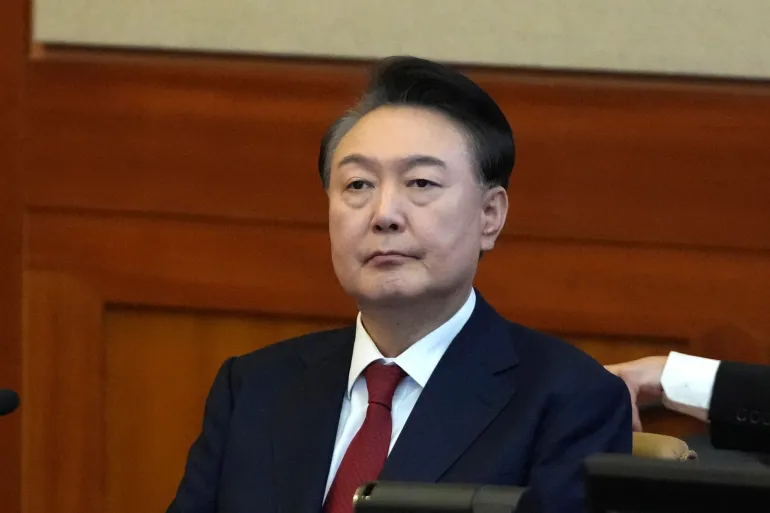
There are five additional defendants. Yoon attended the court session to listen to the concluding legal arguments. He has contended that, in his capacity as president, he possessed the authority to proclaim martial law.
Yoon was reported by Yonhap News Agency as stating that he took such action to prevent the wickedness that would ruin the nation. Legal arguments, initially anticipated to conclude last Friday, extended into Tuesday amid reports that defence attorneys had postponed the proceedings. A Seoul court is anticipated to issue a verdict on Friday regarding an obstruction of justice case, which may result in Yoon receiving a prison sentence of up to 10 years.
And he stands trial on charges of assisting the adversary, stemming from allegations that he authorized drone flights over North Korea to substantiate his declaration of martial law. The Office of President Lee Jae Myung, who was elected following Yoon's removal from office, stated in a formal announcement that it believes the judiciary will rule … in accordance with the law, principles, and public standards..